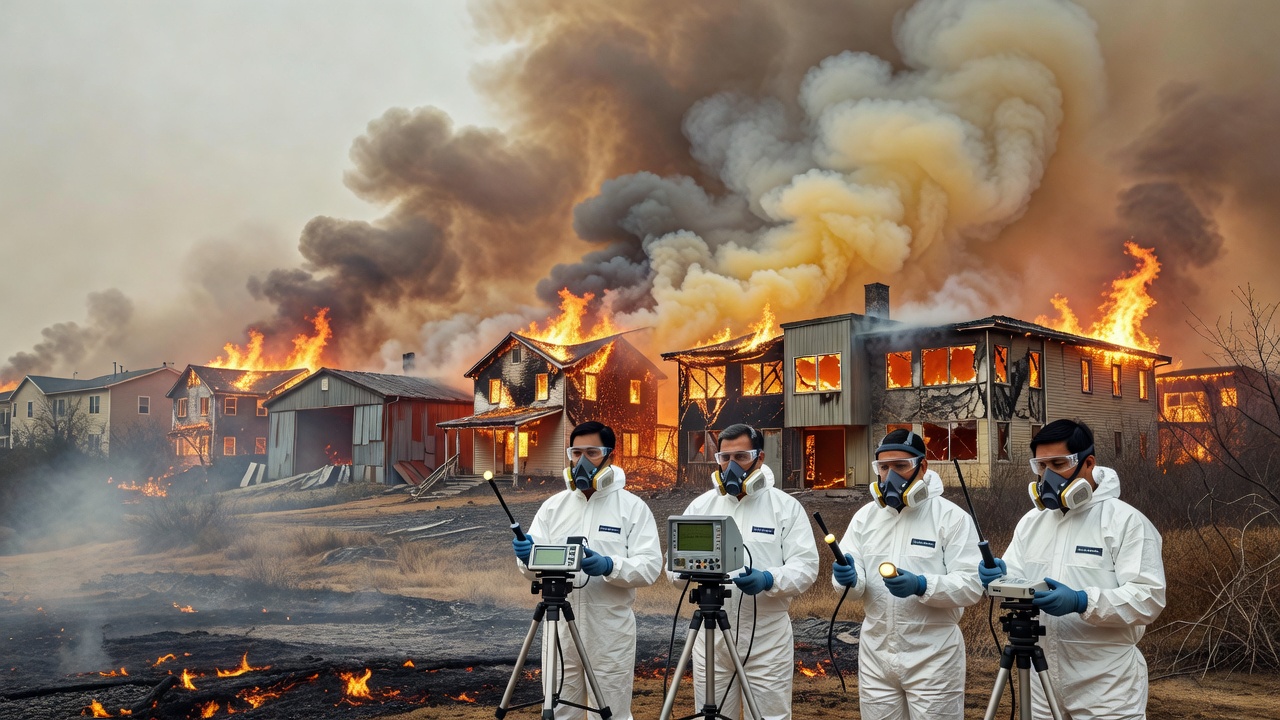
A team of engineers from Worcester Polytechnic Institute and Northeastern University has launched a three-year study to identify the toxic gases and particles released when wildfires consume houses, offices, and other structures, not just trees and brush. The National Science Foundation is funding the project with $1,185,475, of which $817,703 goes to WPI.
Why buildings, not just vegetation
Most wildfire research has historically focused on how flames spread through forests and grasslands. But as development pushes further into wildland areas, fires increasingly reach homes, warehouses, and commercial buildings built from plastics, synthetic insulation, treated wood, and other manufactured materials. According to Shichao Liu, an associate professor in WPI's Department of Civil, Environmental, and Architectural Engineering, those materials can release aerosols and gases that pose a distinct health risk compared with burning plant matter alone. The project aims to characterize what compounds are actually emitted when man-made construction materials ignite under wildfire conditions.
Who is involved
The research brings together Shichao Liu with two colleagues in WPI's Department of Fire Protection Engineering: Albert Simeoni, a professor, and Reza Ziazi, an assistant research professor. Shang Liu, an assistant professor at Northeastern University, is also collaborating on the work. Combining expertise in architectural engineering and fire protection engineering allows the team to examine both the structural and chemical dimensions of how buildings burn and what they release into the air.
What the findings could mean
Understanding which toxic compounds are generated by burning buildings could eventually inform public health guidance for residents and first responders near wildfire zones, as well as building material choices in fire-prone regions. The study is still in its early stages, and the researchers have not yet published specific findings on emission types or concentrations. As the work progresses over the next three years, it is expected to generate data that fills a gap in current wildfire science, which has concentrated largely on vegetation fires rather than the built environment.